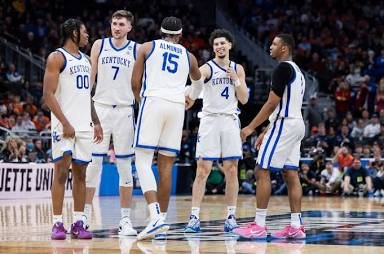
Kentucky’s lineup has taken on a new level of unpredictability this season, and it’s not by accident. Night after night, the Wildcats are reshaping how they deploy their personnel, and opponents are struggling to keep up with a role adjustment that has quietly become one of the program’s biggest advantages.
The shift centers on positional flexibility. Kentucky has leaned into a lineup approach where traditional roles are fluid rather than fixed. Guards are initiating offense from multiple spots, wings are defending up and down the lineup, and forwards are being asked to make quicker decisions as secondary playmakers. The result is a rotation that changes rhythm without changing identity.
This adjustment has had an immediate impact on game flow. Opponents preparing for a predictable starting five are suddenly forced to defend different looks within the same game. Matchups that seem comfortable early quickly become liabilities as Kentucky alters spacing, tempo, and defensive assignments on the fly. What worked for five minutes rarely works for forty.
Defensively, the role shift has been especially disruptive. Kentucky is switching more seamlessly, disguising coverages, and using length across multiple positions to take away first options. Players are no longer tied to guarding a single spot on the floor, which has allowed the Wildcats to close driving lanes and contest shots without sacrificing rebounding.
Offensively, the benefits are just as clear. By redistributing responsibilities, Kentucky has unlocked better ball movement and improved shot quality. When primary scorers are pressured, others step into expanded roles without hesitation. That balance has prevented defenses from loading up on any single player and has kept scoring runs sustainable rather than streaky.
The most telling sign of success is how opponents are responding late in games. Defensive schemes break down as matchups blur, communication slips, and adjustments lag behind Kentucky’s constant movement. While other teams scramble to recalibrate, the Wildcats remain composed, executing within roles that feel interchangeable but well-defined.
As the season continues, this role adjustment is becoming more than a tactical wrinkle — it’s an identity. Kentucky isn’t just playing different lineups; it’s redefining how roles function within them. And until opponents find a reliable answer, that nightly flexibility may continue to give the Wildcats an edge when it matters most.
Leave a Reply