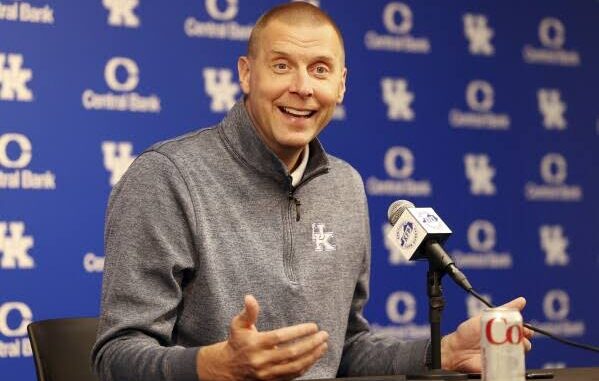
Kentucky Wildcats head coach Mark Pope isn’t the type to hide from hard truths, and this week he proved it again with a brutally honest admission that has fans talking across Big Blue Nation. After a stretch of uneven performances and frustrating losses, Pope revealed that one early-season coaching decision may have altered the course of Kentucky’s season far quicker than anyone anticipated.
Speaking to reporters after practice, Pope explained that the Wildcats tried to fast-track their identity before the team was truly ready for it. In his words, the staff pushed for a system that demanded instant chemistry and near-perfect execution, even though the roster was still learning how to play together.
“We wanted to be great immediately,” Pope said. “And in doing that, I think we skipped a few steps that mattered more than we realized at the time.”
That decision, according to Pope, put Kentucky in a position where small mistakes snowballed into big problems. Instead of building confidence through simpler sets and clearer roles, the Wildcats were thrown into a complex structure that exposed their inexperience. The result was a series of close losses, late-game breakdowns, and stretches of inconsistency that left fans wondering why the team looked so different from night to night.
The coach didn’t point fingers at his players. In fact, he did the opposite.
“This one’s on me,” Pope admitted. “These guys work. They compete. They care. But I asked them to execute at a level that usually comes after months of playing together, not weeks.”
Insiders around the program say the turning point came after a particularly painful defeat that saw Kentucky struggle with spacing, defensive rotations, and late-game decision-making. Film sessions following that game reportedly led to some uncomfortable but necessary conversations inside the locker room—conversations that forced the coaching staff to rethink their approach.
Since then, subtle changes have started to show. Kentucky has simplified parts of its offense, clarified player roles, and emphasized defensive fundamentals over flashy schemes. The difference hasn’t been night-and-day in the win column yet, but the team’s energy and cohesion have noticeably improved.
Players have backed up their coach’s assessment too.
One veteran described the early part of the season as “trying to run before we could really walk together.” Another said the team now feels “more connected” and “more confident” knowing exactly what’s expected on both ends of the floor.
For a program like Kentucky, where expectations are always sky-high, patience is rarely easy to sell. Every loss feels bigger. Every mistake gets magnified. But Pope believes that owning this misstep publicly is part of resetting the culture and the mindset around this group.
“In college basketball, especially with new pieces, you’re building something in real time,” he said. “Sometimes you learn the hard way what your team actually needs first.”
Analysts around the SEC note that Kentucky’s situation isn’t unique. Many teams with new rosters struggle early when systems are installed too aggressively. The difference here is Pope’s willingness to acknowledge it openly—and adjust.
That adjustment could end up being the most important storyline of Kentucky’s season.
Instead of chasing perfection early, the Wildcats are now focused on progress. Practices have reportedly shifted toward repetition, communication, and situational basketball—areas that directly address the problems that showed up during that rough stretch.
There’s still plenty of season left, and in a conference as unforgiving as the SEC, nothing is guaranteed. But inside the program, there’s a growing belief that this setback might become a foundation rather than a failure.
“We’re tougher because of it,” one player said. “We know what doesn’t work. Now we’re building what does.”
For fans, Pope’s admission offers both explanation and hope. Explanation for why a talented Kentucky team looked out of sync early. Hope that the lessons learned the hard way could pay off when it matters most.
As March inches closer, the Wildcats may look back at this moment—not just as a costly mistake—but as the turning point that forced them to become a real team.
And if Pope is right, that early-season miscalculation might end up changing Kentucky’s season… just not in the way anyone first expected.
Leave a Reply